

It’s a widely known fact that most new products that are launched fail. For many small business owners, that reality can make launching new products feel like throwing ideas at the wall to see what sticks. Knowing how to create a successful product launch strategy that includes developing, launching, and promoting the merchandise properly is half the battle.
How Product Launch Stages Are Evolving in 2026
Launching a product today isn’t just about following a checklist – it’s about being visible, adaptable, and data-driven from the start. Search engines, AI tools, and customer expectations have changed how successful product launch stages work.
1. Optimize for answers, not just rankings.
It’s no longer enough to rank on search engines. You also need to show up in AI-generated answers and summaries. That means structuring your content to answer customer questions directly.
To do this effectively:
- Format key launch content in a Q&A style (for example: “What problem does this product solve?”)
- Add FAQ sections to important pages to increase visibility in search and AI tools
- Focus on related topics (topic clusters) instead of relying on a single keyword
This approach helps your product get discovered not just in search results, but in the answers customers see first.
Where Thryv fits:
Thryv helps businesses create search- and answer-ready content, from optimized landing pages to automated review generation, building credibility and improving visibility.
2. Use AI to validate and personalize before launch.
Before your product even launches, AI can help you refine your strategy and better understand your audience.
With AI, you can:
- Build detailed customer profiles (personas) based on real data
- Test messaging, pricing, and positioning before going live
- Personalize outreach across email, text, and social channels automatically
This reduces guesswork and helps ensure your product resonates from day one.
Where Thryv fits:
With Thryv’s CRM and automation tools, businesses can segment audiences, personalize outreach, and automate follow-ups, turning early interest into real revenue.
3. Treat product launches as a continuous growth loop.
The most successful product launch stages don’t end at launch; they evolve. Instead of a one-time event, think of your launch as a cycle:
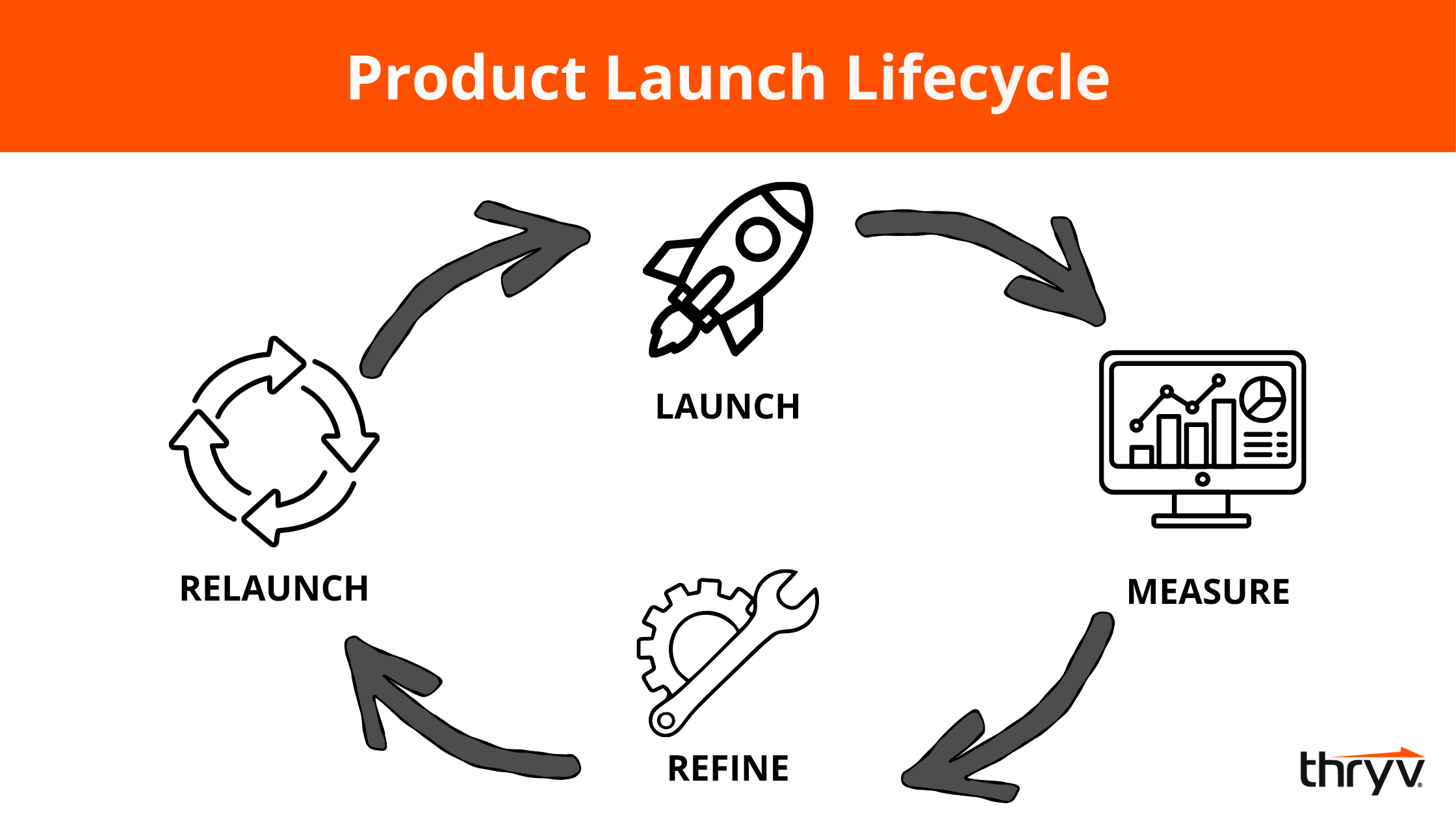
By tracking performance and customer behavior, you can continuously improve your product and messaging.
- Use data to see what’s working (and what’s not)
- Adjust campaigns based on real customer feedback
- Keep optimizing long after the initial launch
Where Thryv fits:
Thryv centralizes your marketing, communication, and reporting, so you can track ROI, automate campaigns, and make updates faster without juggling multiple tools.
10 Product Launch Stages
1. Meet user needs.
2. Know your competition.
3. Make a prototype and test it.
4. Reconfigure your product.
5. Run the numbers.
6. Build anticipation by pre-marketing.
7. Build a solid supply chain.
8. Network and share your product.
9. Reach out to the press post-launch.
10. Consider public feedback post-launch.
1. Meet user needs.
A good product launch plan should always put consumers’ needs first and satisfy them the best way possible. An effective way to do this is to survey the market and answer the question: “Why would someone buy your product?” Figure out how your product could solve a problem, satisfy a desire, or improve someone’s quality of life. These are all reasons why people buy things. What is your product worth to your customers? Not “worth” in the way of monetary value, but how it adds value to their general state of living. Understanding how your customers justify buying your product is the first step in developing a promotional strategy.
2. Know your competition.
What sets your company and your product apart from a similar brand or product? Why should consumers choose your product over the competition? What is it about Dunkin’ Donuts’ coffee that people prefer over Starbucks’? The brand? The flavor? The price? Identify your company’s unique advantages. How can you grab your audience’s attention so they trust that your product will deliver what other companies can’t?
3. Make a prototype and test it.
To avoid investing in a product that is defective before it hits the market, hire beta testers to try it and provide feedback on how to improve it, if necessary. This will help your business avoid undesirable customer reviews that may damage your credibility in the industry, prompting partners and investors to engage in damage control to justify their involvement with your brand.
Try the Upgraded Thryv Marketing CenterTM
See what’s new — and why it gives your business an edge.

4. Reconfigure your product.
Once you start testing your product and gather feedback from testers, friends, family, colleagues, and anyone who can help identify kinks, it’s imperative to adjust accordingly. Making subtle changes here and there can mean a world of difference in the product’s quality. Some of your friends may ask about a feature that you’ve never considered adding, or point out that something isn’t quite working that you can eliminate. Ultimately, your product should “spark joy” and interest; it should be something consumers not just need, but want.
5. Run the numbers.
It’s wise to establish your profit margins as one of your product launch phases. Look at your existing products’ performance, if applicable, and determine the number of products sold, total revenue generated, break-even sales volume, and net profit earned. Then work backward to determine which numerical goals make the most sense. You need to decide what a reasonable website conversion rate is and then figure out how much traffic you’d need to reach that goal.
6. Build anticipation by pre-marketing.
A successful product launch plan is only as good as the work your marketing department puts into it. If you build anticipation among your audience by promoting the product before launch, awareness will be higher, which will help drive more sales for the new product.
A few clever ways to initiate a new product promo involve:
- Create a landing page about the new product on your website.
- Create an email campaign that encourages signups to learn more about the product with a CTA.
- Reach out to bloggers, journalists, and industry influencers who can help create content that will tease the product.
- Reach out to PR reps to create an embargoed press release that will have all media outlets talking about your product at the same time when it launches.
- Depending on your budget, you should advertise in as many appropriate places as possible that receive enough traffic to generate interest.
- Create the content early so you have perfected the ad copy and images to use when your product is ready to be presented.

Free Guide: How-to Guide: 4 Ways to Run an Efficient Small Business
We’re sharing our expert tips to help you boost productivity, eliminate time-wasting tasks, and more in this free guide.
Download
7. Build a solid supply chain.
Business owners need to take inventory of their products and ensure they have enough to meet demand. The best way to do this is to establish a manageable supply chain. Work closely with your vendors and ask them what their maximum capacity is for the number of units they can provide at one time. Then, collaborate on how to scale production if your product launch generates more demand than supply.
8. Network and share your product.
It’s time to launch! Once you’ve set a launch date, stick to it. This will mitigate the need to update the media, customers, vendors, and anyone involved about any changes.
When it’s time, promote the new product on your landing page, in your email campaigns, and on social media, and encourage your contacts to spread the word as well. Don’t hold back; make sure you get the public’s attention on every platform available. And if necessary, repost and share reminders in the days following launch.
9. Reach out to the press post-launch.
Once you’ve launched your product, and good reviews and feedback start rolling in, reach out to the PR firms and media outlets that covered your story pre-launch and ask them to share an update. Take your audience on a journey from inception to production to commerce. People love hearing the origin story of a great product, especially if it started as an accident. According to Mental Floss, Corn Flakes, the Slinky, Silly Putty, Post-It Notes, and others were made unintentionally. Does your company have a great product story? If so, tell your story on your website, on social media, and to the press.
10. Consider public feedback post-launch.
Now that the product is available, brace yourself for customer reviews. Yelp, Google, and other customer-feedback sites are the modern-day consumer reports. No matter how successfully you’ve introduced your product to the world via a comprehensive product launch plan, public perception of your brand can be brutal if your organization overpromises and underdelivers.
If you receive a negative review, be empathetic, respond with a positive greeting, and provide a short-term solution to address the consumer’s immediate concerns and a long-term solution to ensure future customers won’t encounter the same issues. Addressing reviews and feedback whenever possible demonstrates how invested you are in your product and your customers’ happiness, which will, in the end, result in greater loyalty and devotion to your brand.
Turning Product Launch Stages Into Long-Term Growth
Launching a new product isn’t just about getting it to market; it’s about setting it up for sustained success. While these product launch stages provide a strong foundation, the most successful businesses go a step further by continuously learning, adapting, and improving over time.
From understanding your audience and testing your product to building anticipation and responding to feedback, each stage plays a role in reducing risk and increasing your chances of success. And in today’s landscape, that success depends on more than just execution – it requires visibility in search and AI-driven answers, personalized customer experiences, and the ability to adjust quickly based on real data.
The Guide to Running an Efficient Small Business
Boost productivity and cut time-wasting tasks with expert tips in this free guide.
FAQs
Q: What are the product launch stages?
A: Product launch stages typically include identifying customer needs, analyzing competitors, building and testing a prototype, refining the product, setting pricing and goals, pre-marketing, preparing operations, launching, promoting post-launch, and gathering customer feedback. Together, these stages help reduce risk and improve your chances of success.
Q: How can I use AI to launch my product?
A: AI can help you validate your product idea, build customer personas, test messaging, and predict performance before launch. It can also automate marketing efforts like email, text, and social campaigns, while analyzing real-time data so you can adjust your strategy quickly.
Q: What are the 4 P’s of a product launch?
A: The 4 P’s of a product launch are Product, Price, Place, and Promotion. These represent what you’re selling, how much it costs, where it’s available, and how you market it. Together, they form the foundation of your go-to-market strategy.
Q: Why do most product launches fail?
A: Many product launches fail because they don’t fully address customer needs, lack proper market research, or rely on guesswork instead of data. Poor timing, weak messaging, and limited visibility can also impact results. Following structured product launch stages and using data to guide decisions can significantly improve outcomes.